Kamis, 09 Desember 2010

CCNA Discovery 3 Module 7 Exam Answers Version 4.0

1. Why are Network Control Protocols used in PPP?
• to establish and terminate data links
• to provide authentication capabilities to PPP
• to manage network congestion and to allow quality testing of the link
• to allow multiple Layer 3 protocols to operate over the same physical link

2. What is the data transmission rate for the DS0 standard?
• 44 kb/s
• 64 kb/s
• 1.544 Mb/s
• 44.736 Mb/s

3. In which two layers of the OSI model are key differences found between a LAN and a WAN. (Choose two.)
• Layer 1
• Layer 2

• Layer 3
• Layer 4
• Layer 6
• Layer 7

4. Which statement is true about the Cisco implementation of the HDLC protocol?
• It supports authentication.
• It has a universally compatible frame format.
• It is the default encapsulation for serial interfaces on Cisco routers.
• It does not support multiple protocols across a single link.

5.
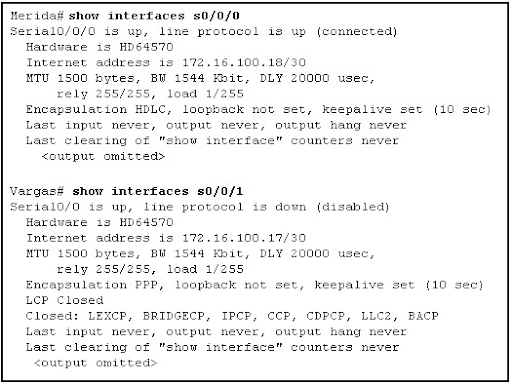
image
Refer to the exhibit. A network administrator has a connectivity problem between the serial interfaces of Merida and Vargas. What is the cause of the problem?
• Authentication is required on the serial link.
• The encapsulation is misconfigured.
• The IP addresses are on different subnets.
• The serial interface on Vargas is shutdown.
• The loopback interfaces on both routers are not configured.

6.
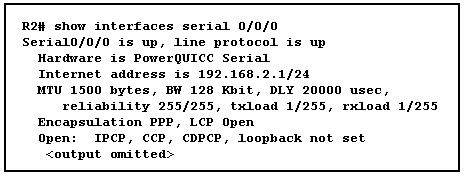
image
Refer to the exhibit. What statement is true about the exhibited output?
• LCP is in the process of negotiating a link.
• LCP and NCP are waiting for CHAP authentication to complete.
• LCP negotiation has completed successfully, but NCP negotiation is in progress.
• LCP and NCP negotiation is complete, and the data link service is available to carry packets.

7. Which three statements are true regarding LCP? (Choose three.)
It is responsible for negotiating link establishment.
• It negotiates options for Layer 3 protocols running over PPP.
• It uses MD5 encryption while negotiating link-establishment parameters.
It terminates the link upon user request or the expiration of an inactivity timer.
• It can test the link to determine if link quality is sufficient to bring up the link.

• It monitors the link for congestion and dynamically adjusts the acceptable window size.

8. Why are Frame Relay paths referred to as virtual?
• Frame Relay PVCs are created and discarded on demand.
• The connections between PVC endpoints act like dialup circuits.
• There are no dedicated circuits to and from the Frame Relay carrier.
• The physical circuits inside the Frame Relay cloud do not contain exclusive links for a specific Frame Relay connection.

9. What best describes the use of a data-link connection identifier (DLCI)?
• an address identifying a virtual circuit
• a logical address identifying the DCE device
• an address identifying a Layer 3 service across a Frame Relay network
• a logical address identifying the physical interface between a router and a Frame Relay switch

10. What two services allow the router to dynamically map data link layer addresses to network layer addresses Frame Relay network? (Choose two.)
• ARP
• ICMP
• Proxy ARP
• Inverse ARP
• LMI status messages


11. Which three statements describe functions of the Point-to-Point Protocol with regards to the OSI model?(Choose three.)
• operates at all layers of the OSI model
• provides a mechanism to multiplex several network layer protocols
• can be configured on both synchronous and asynchronous serial interfaces

• uses Layer 3 of the OSI model to establish and maintain a session between devices
• uses the data link layer to configure such options as error detection and compression
• uses network control protocols to test and maintain connectivity between devices

12. At what physical location does the responsibility for a WAN connection change from the user to the service provider?
• demilitarized zone (DMZ)
• demarcation point
• local loop
• cloud

13. What does a Frame Relay switch use to inform the sender that there is congestion?
• FECN
• BECN
• DE
• FCS

14.
image
Refer to the exhibit. What statement is true about the debug output?
• R2 is using PAP instead of CHAP.
• The routers have different CHAP passwords configured.
• The administrator performed a shutdown on the R2 PPP interface during negotiation.
• The Layer 3 protocol negotiation caused the connection failure.

15. Which two statements describe the function of time-division multiplexing? (Choose two.)
• Multiple data streams share one common channel.
• Conversations that require extra bandwidth receive any unused time slices.
• Time slots are utilized on a first-come, first-served basis.
• Time slots go unused if a sender has nothing to transmit.
• Priority can be dedicated to one data source.

16. When customers use credit cards to make purchases at a small business, a modem is heard dialing a telephone number to transfer the transaction data to the central office. What type of WAN serial connection is in use?
• leased line
• point-to-point
• circuit switched
• packet switched

17. Which best describes data communications equipment (DCE)?
• serves as data source and/or destination
• responsible for negotiating windowing and acknowledgements
• physical devices such as protocol translators and multiplexers
• equipment that forwards data and is responsible for the clocking signal

18. Permanent virtual circuits and switched virtual circuits are both part of which option for WAN connectivity?
• leased line
• cell switching
• packet switching
• circuit switching

19. Which field of a frame uses error detection mechanisms to verify that the frame is not damaged intransit?
• FCS
• MTU
• flag
• control
• protocol

20. What occurs in the encapsulation process as a data packet moves from a LAN across a WAN?
• The Layer 2 encapsulation changes to a format that is appropriate for the WAN technology.
• The Layer 3 encapsulation changes to a format that is appropriate for the WAN technology.
• Both Layer 2 and Layer 3 encapsulation change to a technology that is appropriate for the WAN.
• Both Layer 2 and Layer 3 encapsulation remain constant as the data packet travels throughout the network.

21.
image
Refer to the exhibit. The network administrator is configuring R1 to connect to R2, which is a non-Cisco router. Which encapsulation method will need to be configured for communication to occur?
• HDLC
• HSSI
• ISDN
• IPCP
• PPP

22. A company is implementing dialup services for remote workers to connect to the local network. The company uses multiple Layer 3 protocols and requires authentication for security. Which protocol should be used for this remote access?
• LMI
• PPP
• HDLC
• Frame Relay

23. Which two options can LCP negotiate? (Choose two.)
• compression
• authentication

• dynamic flow control
• network layer address for IP
• connection-oriented or connectionless communication methods

24. What statement best describes cell switching?
• It uses a dedicated path between endpoints.
• It creates a permanent physical link between two points.
• It uses DLCIs to identify virtual circuits.
• It creates fixed-length packets that traverse virtual circuits.

CCNA Discovery 3 Module 6 Exam Answers Version 4.0

1.
1
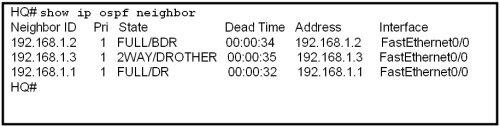
Refer to the exhibit. What statement describes the DR/BDR relationship of the HQ router?
• HQ is the DR.
• HQ is the BDR.
• HQ is a DROTHER.
• HQ is a member of an NBMA network.

2. Which two features are associated with Frame Relay OSPF point-to-multipoint environments? (Choose two.)
• A DR is not elected.
• The OSPF priority value determines the active DR on the Frame Relay link.
• OSPF neighbor routers are statically defined.
• The link types are identified as broadcast multiaccess.
• The BDR will have a router ID whose value is greater than the DR router ID.

3.
2
Refer to the exhibit. How was the OSPF default gateway entry for R2 determined?
• Default routes are automatically injected by OSPF into all advertisements.
• A static default gateway route is defined in the configuration of R2.
• The default-information originate command is applied on R1.
• The ISP defines the gateway of last resort and automatically passes it to R1 and R2.
• The ip default-gateway command is applied on R2.

4. What is always required for OSPF routers to share routing information?
• designated routers
• a backup designated router
• neighbor adjacencies
• an NBMA network topology
• links that are configured on the 224.0.0.0 network

5.
3
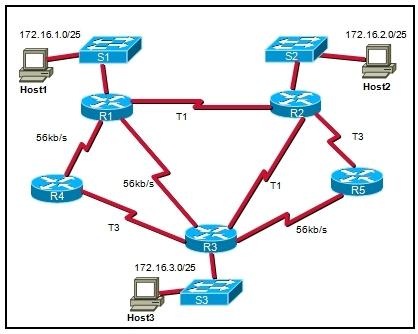
Refer to the exhibit. A network administrator has implemented OSPF and the network has converged. If all router interfaces are enabled and functional, what route will OSPF view as lowest cost when moving frames from Host3 to Host1?
• R3 to R4 to R1
• R3 to R1
• R3 to R2 to R1
• R3 to R5 to R2 to R1

6.
4
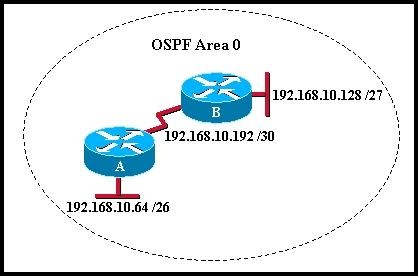
Refer to the exhibit. Which commands configure router A for OSPF?
• router ospf 1
network 192.168.10.0
• router ospf 1
network 192.168.10.64 0.0.0.63 area 0
network 192.168.10.192 0.0.0.3 area 0

• router ospf 1
network 192.168.10.64 255.255.255.192
network 192.168.10.192 255.255.255.252
• router ospf 1
network 192.168.10.0 area 0

7.
5
Refer to the exhibit. Which network statement configures the home router to allow all the interfaces to participate in OSPF?
• network 10.0.0.0 0.3.255.255 area 0
• network 10.8.0.0 0.0.0.3 area 0
• network 10.8.0.0 0.3.255.255 area 0
• network 10.10.0.0 0.0.0.3 area 0
• network 10.12.0.0 0.3.255.255 area 0

8. Which statement is true regarding OSPF DR and BDR elections?
• A new DR/BDR election occurs each time a new OSPF neighbor is added.
• The router with the highest OSPF priority setting wins the election for DR.
• The default priority value for a router connected to a multi-access network is 0.
• The router with the highest MAC address is elected as the DR when the default priority values are used.

9.
6
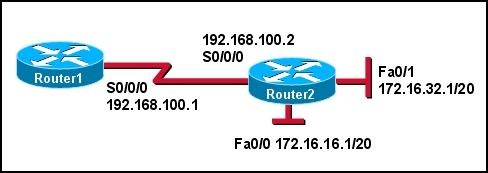
Refer to the exhibit. The network administrator would like only the 172.16.32.0 network advertised to Router1. Which OSPF network command accomplishes this?
• Router2(config-router)# network 172.16.0.0 0.0.0.15 area 0
• Router2(config-router)# network 172.16.0.0 0.0.15.255 area 0
• Router2(config-router)# network 172.16.32.0 0.0.15.255 area 0
• Router2(config-router)# network 172.16.32.0 0.0.255.255 area 0

10. Which two statements describe the operation of link-state routing protocols? (Choose two.)
• All routers in the same area have identical link-state databases when converged.
• Routing loops are prevented by running the Diffusing Update Algorithm (DUAL).
• Link-state routers send frequent periodic updates of the entire routing table.
• Reliable Transport Protocol (RTP) is used to deliver and receive LSAs.
• Calculating the shortest path for each destination is accomplished with the SPF algorithm.

11.
7
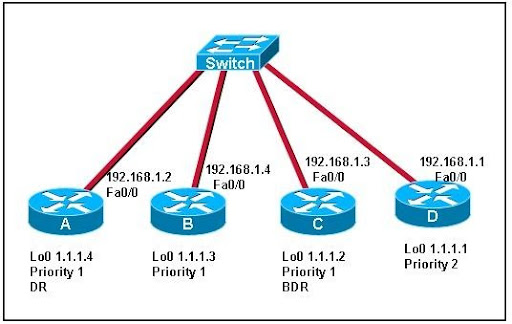
Refer to the exhibit. Routers A, B, and C are part of the existing OSPF network. Router D has been added to the network. All routers are running OSPF and have the indicated priorities applied to the interface. What is the DR/BDR status immediately after router D is added to the existing network?
• An election is forced and router D wins the DR election.
• The DR and BDR do not change until the next election.
• An election is forced and the existing BDR becomes the DR.
• The router with the highest router ID becomes the new BDR.

12. Which two statements describe the use of OSPF DR/BDR elections? (Choose two.)
• Elections are always optional.
• Elections are required in all WAN networks.
• Elections are required in point-to-point networks.
• Elections are required in broadcast multiaccess networks.
• Elections are sometimes required in NBMA networks.

13.
8
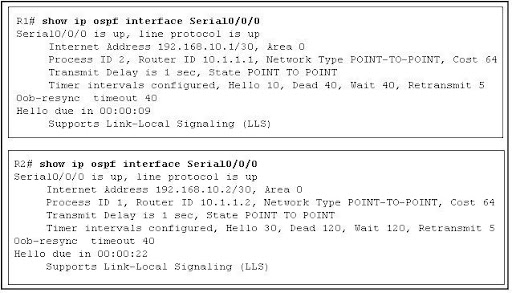
Refer to the exhibit. As part of an OSPF network, R1 and R2 are trying to become adjacent neighbors. Although it appears that the two systems are communicating, neither of the routing tables include OSPF routes received from its neighbor. What could be responsible for this situation?
• R1 and R2 are not on the same subnet.
• The Process IDs on each router do not match.
• The timer intervals on the routers do not match.
• The value set for the Transmit Delay time on both routers is too low.

14.
9
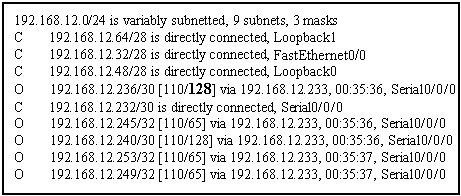
Refer to the exhibit. What is the purpose of the value 128 shown in bold?
• It is the OSPF cost metric.
• It is the OSPF administrative distance.
• It is the value assigned by the Dijkstra algorithm that designates the distance in hops to the network.
• It is the value assigned to an interface that is used by the DUAL algorithm to determine the metric.

15.
10
Refer to the exhibit. What is the purpose of the configuration commands added on router B?
• allows router A to form an adjacency with router B
• provides a stable OSPF router ID on router B
• provides a method of testing router traffic
• creates the OSPF adjacency table on router B

16.
11
Refer to the exhibit. The command ip route 10.16.1.64 255.255.255.252 s0/0/0 is entered into the router. Why does network 10.16.1.64/30 appear in the routing table in addition to network 10.16.1.64/27?
• The router views 10.16.1.64/30 and 10.16.1.64/27 as two different networks.
• The static route is used as a backup route for packets destined for 10.16.1.64/27.
• The AD for static routes is lower than the AD for OSPF routes.
• The static route metric is lower than the OSPF metric for the 10.16.1.64/27 network.

17. What is the primary difference between link-state protocols and distance vector protocols with regard to route calculation?
• Distance vector protocols take existing routes from their neighbors and add to them. Link-state protocols independently calculate full routes.
• Link-state protocols calculate and pass full routing tables to all routers in their associated areas, and distance vector protocols do not.
• When determining invalid routes, link-state protocols use split horizon for all route computations. Distance vector protocols use reverse poisoning.
• Distance vector protocols require more CPU and RAM for route calculations than link-state protocols require.

18. What range of networks are advertised in the OSPF updates by the command Router1(config-router)# network 192.168.0.0 0.0.15.255 area 0?
• 192.168.0.0/24 through 192.168.0.15/24
• 192.168.0.0/24 through 192.168.15.0/24
• 192.168.15.0/24 through 192.168.31.0/24
• 192.168.15.0/24 through 192.168.255.0/24
• 192.168.16.0/24 through 192.168.255.0/24

19.
12
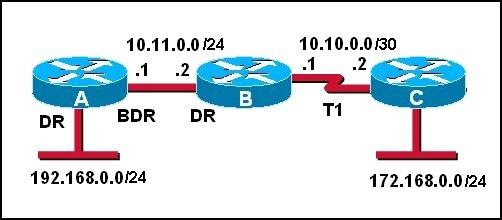
Refer to the exhibit. When establishing adjacency relationships, which IP address would router A use to send hello packets to router B?
• 10.11.0.1
• 10.11.0.2
• 10.11.0.255
• 224.0.0.5
• 255.255.255.255

20.
13
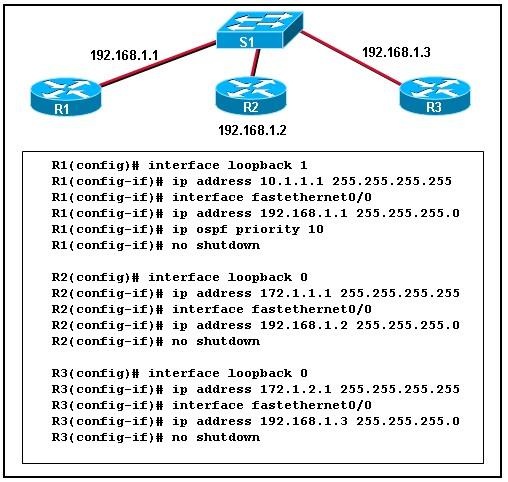
Refer to the exhibit. Which router will be elected the DR and which will become the BDR?
• R1 will be DR and R2 will be BDR.
• R1 will be DR and R3 will be BDR.
• R2 will be DR and R1 will be BDR.
• R2 will be DR and R3 will be BDR.
• R3 will be DR and R2 will be BDR.
• R3 will be DR and R1 will be BDR.

21. When compared to a distance vector routing protocol, what is a benefit of the hierarchical design approach that is used in large OSPF networks?
• simpler configuration
• reduction of router processing requirements
• isolation of network instability
• less complex network planning

22. What are two advantages of using a link-state routing protocol instead of a distance vector routing protocol? (Choose two.)
• The topology database eliminates the need for a routing table.
• Frequent periodic updates are sent to minimize the number of incorrect routes in the topological database.
• Routers have direct knowledge of all links in the network and how they are connected.
• After the initial LSA flooding, routers generally require less bandwidth to communicate changes in a topology.

• A link-state routing protocol requires less router processor power.

23. If a network has converged, what is true about the link-state database held by each router in the same OSPF area?
• Each router has a link-state database containing the same status information.
• Each router has a different link-state database depending on its position within the network.
• The link-state database is stored in a designated router and is accessed by each router in the area as needed.
• The link-state database in each router only contains information about adjacent routers and the status of their links.

24.
14
Refer to the exhibit. RTRC was recently configured and is not sending the proper OSPF routes to RTRB, as shown in the RTRB routing table. Based on the RTRC configuration, what is most likely the problem?
• RTRC interfaces are administratively shut down.
• The OSPF process ID for RTRC does not match the process ID used on RTRB.
• The interface addresses on RTRC overlap with other addresses in the network.
• The OSPF routing configuration on RTRC has a missing or incorrect network statement.

Rabu, 08 Desember 2010

CCNA Discovery 3 Module 5 Exam Answers Version 4.0

1. What three statements are true about routers that are configured for EIGRP? (Choose three.)
• They can support multiple routed protocols
• They can support only link-state protocols.
• They send their entire routing tables to neighboring routers.
• They send partial routing updates in response to topology changes.
• They send routing updates to all other routers in the network.
• They use hello packets to inform neighboring routers of their status.

2. Given the following commands:
Router(config)# router rip
Router(config-router)# network 192.31.7.0
What three conclusions can be determined based on the commands used on the router? (Choose three.)
• A link-state routing protocol is used.
• A distance vector routing protocol is used.
• Routing updates broadcast every 30 seconds.

• Routing updates broadcast every 90 seconds.
• Hop count is the only metric used for route selection.
• Bandwidth, load, delay, and reliability are metrics used for route selection.

3. What is indicated when an EIGRP route is in the passive state?
• The route has the highest path cost of all routes to that destination network.
• The route must be confirmed by neighboring routers before it is put in the active state.
• The route is a feasible successor and will be used if the active route fails.
• There is no activity on the route to that network.
• The route is viable and can be used to forward traffic.

4. What two problems may occur if the EIGRP default bandwidth for a serial link is higher than the actual bandwidth? (Choose two.)
• Routing updates will arrive too quickly for receiving routers to process.
• The port IP address will be rejected by the routing protocol.
Suboptimal paths will be selected.
• The port protocol will return to the HDLC default.
• VLSM support will be disabled.
• Network convergence may be affected.

5. What is the default administrative distance for EIGRP internal routes?
• 70
• 90
• 100
• 110
• 120
• 255

6. A network administrator issues the command show ip route and sees this line of output:
192.168.3.0/24 [120/2] via 192.168.2.2, 00:00:05, Serial0/0
What two pieces of information can be obtained from the output? (Choose two.)
• RIP is the routing protocol configured.
• This is a static route to network 192.168.3.0.
• The metric for this route is 2.
• The next periodic update is in 5 seconds.
• The autonomous system number is 120.

7.
1
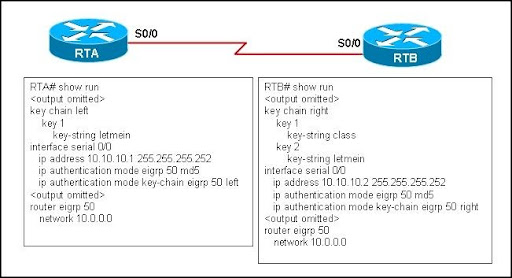
Refer to the exhibit. Which statement is true about the EIGRP authentication configuration?
• RTA and RTB will accept updates from each other.
• RTA and RTB will not accept updates from each other because key 1 on RTB does not match RTA.
• RTA and RTB will not accept updates from each other because the key chain names do not match.
• The ip authentication mode AS does not match the locally configured AS.

8. Which Layer 4 protocol does EIGRP use to provide reliability for the transmission of routing information?
• DUAL
• IP
• PDM
• RTP
• TCP
• UDP

9.
2
Refer to the exhibit. Routers RTR-1 and RTR-3 are completely configured. The administrator needs to configure the routing protocol on router RTR-2 so that communication occurs throughout the network. Which group of commands will successfully configure EIGRP on RTR-2?
• RTR-2(config)# router eigrp 1
RTR-2(config-router)# network 198.18.76.0

• RTR-2(config)# router eigrp 1
RTR-2(config-router)# network 198.18.76.0 0.0.0.3 no-summary
RTR-2(config-router)# network 198.18.76.4 0.0.0.3 no-summary
RTR-2(config-router)# network 198.18.76.128 0.0.0.192 no-summary
• RTR-2(config)# router eigrp 1
RTR-2(config-router)# network 198.18.76.0 0.0.0.3 area 0
RTR-2(config-router)# network 198.18.76.4 0.0.0.3 area 0
RTR-2(config-router)# network 198.18.76.192 0.0.0.192 area 0
• RTR-2(config)# router eigrp 1
RTR-2(config-router)# network 198.18.76.0 0.0.0.3
RTR-2(config-router)# network 198.198.76.4 0.0.0.3
RTR-2(config-router)# network 198.198.76.128 0.0.0.192

10. What prevents RIPv1 updates from being correctly advertised?
• an increase in network load
• the use of variable length subnet masks
• the use of multiple Layer 3 networks on the same router
• a variation in connection speeds on the links to a destination
• a mismatch between the configured bandwidth and the actual bandwidth of a link

11. What does a router that is running RIP use to determine the best path to take when forwarding data?
• the host portion of the network address
• the speed of network convergence
• the calculated metric for the destination network
• the number of broadcasts occurring on an interface
• the number of errors occurring on an interface

12. What is the purpose of the network command when RIP is being configured as the routing protocol?
• It identifies the networks connected to the neighboring router.
• It restricts networks from being used for static routes.
• It identifies all of the destination networks that the router is allowed to install in its routing table.
• It identifies the directly connected networks that will be included in the RIP routing updates.

13. How do EIGRP routers establish and maintain neighbor relationships?
• by exchanging neighbor tables with directly attached routers
• by comparing known routes to information received in updates
• by exchanging hello packets with neighboring routers
• by dynamically learning new routes from neighbors
• by exchanging routing tables with directly attached routers

14.
3
Refer to the exhibit. Routers A and B have EIGRP configured and automatic summarization has been disabled on both routers. Which router command will summarize the attached routes?
• ip area-range eigrp 1 192.168.10.80 255.255.255.224
• ip summary-address eigrp 1 192.168.10.64 255.255.255.192
• ip summary-address 192.168.10.80 0.0.0.31
• ip summary-address eigrp 1 192.168.10.64 0.0.0.63
• ip area-range eigrp 1 192.168.10.64 255.255.255.224

15. How often does RIPv2 send routing table updates, by default?
• every 30 seconds
• every 45 seconds
• every 60 seconds
• every 90 seconds

16.
4
Refer to the exhibit. A network administrator is troubleshooting a routing problem. When the show ip route command is entered on RTR-1, only the serial link between RTR-2 and RTR-3 has been learned from the RIP routing protocol. What are two issues? (Choose two.)
• RIPv1 is a classful routing protocol.
• RIPv1 does not support subnetting.
• The Ethernet networks on RTR-2 and RTR-3 were not entered correctly in the network statements on these routers.
• RIPv1 does not support VLSM.

• RIPv1 is a classless routing protocol.

17. What two statements are correct regarding EIGRP authentication? (Choose two.)
• EIGRP authentication uses the MD5 algorithm.
• EIGRP authentication uses a pre-shared key.

• EIGRP authentication requires that both routers have the same key chain name.
• EIGRP authentication uses varying levels of WEP to encrypt data exchanged between routers.
• EIGRP authentication can be configured on one router and updates from this router are protected; whereas a neighbor router can be without the authentication configuration and its updates are unprotected.

18. When should EIGRP automatic summarization be turned off?
• when a router has not discovered a neighbor within three minutes
• when a router has more than three active interfaces
• when a network contains discontiguous network addresses
• when a router has less than five active interfaces
• when a network addressing scheme uses VLSM

19. What is the maximum number of hops that RIP will attempt before it considers the destination unreachable?
• 14 hops
• 15 hops
• 16 hops
• 17 hops

20. What two statements are true regarding EIGRP tables? (Choose two.)
• A feasible successor route can be found in the topology table.
• A successor route can only be found in the routing table.
• The topology table shows whether a route is in the passive or active state.
• The routing table shows the amount of time elapsed since a router adjacency was formed.
• The neighbor table shows all adjacent Cisco devices.
• Administrative distance is shown as a column in the neighbor table.

21.
5
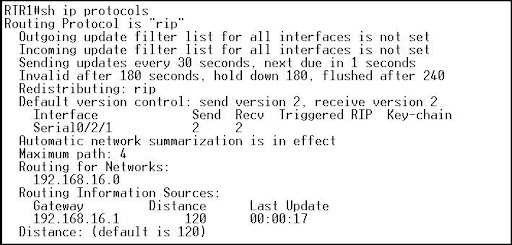
Refer to the exhibit. Which statement is true about the output from the show ip protocols command?
• RIPv2 is configured on this router.
• Auto summarization has been disabled.
• The next routing update is due in 17 seconds.
• 192.168.16.1 is the address configured on the local router

Rabu, 01 Desember 2010

CCNA Discovery 3 Module 4 Exam Answers Version 4.0

1. A network engineer is implementing a network design using VLSM for network 192.168.1.0/24. After subnetting the network, the engineer has decided to take one of the subnets, 192.168.1.16/28 and subnet it further to provide for point-to-point serial link addresses. What is the maximum number of subnets that can be created from the 192.168.1.16/28 subnet for serial connections?
• 1
• 2
• 4
• 6
• 8
• 16

2. When running NAT, what is the purpose of address overloading?
• limit the number of hosts that can connect to the WAN
• allow multiple inside addresses to share a single global address
• force hosts to wait for an available address
• allow an outside host to share inside global addresses

3. What two advantages does CIDR provide to a network? (Choose two.)
• reduced routing table size
• dynamic address assignment
• automatic route redistribution
• reduced routing update traffic
• automatic summarization at classful boundaries

4. How does a router keep track of which inside local address is used when NAT overload is configured?
• The router adds an additional bit to the source IP address and maintains a separate table.
• The router modifies the QoS field.
• The router uses TCP or UDP port numbers.
• The router uses a manual entry that is created and maintained in the database of the router.

5. What is a characteristic of a classful routing protocol on the network?
• All subnets are seen by all routers.
• CIDR addresses are advertised.
• A subnet can be further subnetted down and advertised correctly.
• Updates received by a router in a different major network have the default mask applied.

6. Refer to the exhibit. Which address is an inside global address?
• 10.1.1.1
• 10.1.1.2
• 198.18.1.55
• 64.100.0.1

7. Refer to the exhibit. All networks that are shown have a /24 prefix. Assuming that all routes have been discovered by all routers in the network, which address will successfully summarize only the networks that are shown?
• 192.168.8.0/21
• 192.168.8.0/24
• 192.168.16.0/20
• 192.168.16.0/21
• 192.168.16.0/24

8. What is the CIDR prefix designation that summarizes the entire reserved Class B RFC 1918 internal address range?
• /4
• /8
• /12
• /16
• /20

9. Which NAT term refers to the IP address of your inside host as it appears to the outside network?
• inside global IP address
• outside global IP address
• inside local IP address
• outside local IP address

10. A network administrator is asked to design a new addressing scheme for a corporate network. Presently, there are 500 users at the head office, 200 users at sales, 425 at manufacturing, and 50 at the research site. Which statement defines the correct VLSM addressing map with minimal waste using the 172.16.0.0/16 network?
• 172.16.0.0/20 head office
172.16.1.0/21 manufacturing
172.16.1.0/22 sales
172.16.3.0/26 research
• 172.16.48.0/19 head office
172.16.16.0/20 manufacturing
172.16.48.128 sales
172.16.48.0/26 research
• 172.16.2.0/23 head office
172.16.4.0/23 manufacturing
172.16.6.0/24 sales
172.16.7.0/26 research

• 172.16.2.0/22 head office
172.16.3.0/23 manufacturing
172.16.4.0/26 sales
172.16.4.128/25 research

11. A company using a Class B IP addressing scheme needs as many as 100 subnetworks. Assuming that variable length subnetting is not used and all subnets require at least 300 hosts, what subnet mask is appropriate to use?
• 255.255.0.0
• 255.255.240.0
• 255.255.254.0
• 255.255.255.0
• 255.255.255.128
• 255.255.255.192

12. Host A in the exhibit is assigned the IP address 10.118.197.55/20. How many more network devices can be added to this same subnetwork?
• 253
• 509
• 1021
• 2045
• 4093

13. Refer to the exhibit. RIP version 2 is configured as the network routing protocol and all of the default parameters remain the same. Which update is sent from R2 to R3 about the 10.16.1.0/24 network connected to R1?
• 10.16.0.0/16
• 10.0.0.0/24
• 10.0.0.0/8
• 10.16.1.0/24

14. What range of networks are summarized by the address and mask, 192.168.32.0/19?
• 192.168.0.0/24 - 192.168.32.0/24
• 192.168.0.0/24 - 192.168.31.0/24
• 192.168.32.0/24 – 192.168.64.0/24
• 192.168.32.0/24 – 192.168.63.0/24

15. Refer to the exhibit. Based on the output of the show ip nat translations command, which kind of address translation is in effect on this router?
• static
• public
• overload
• private

16. How many addresses will be available for dynamic NAT translation when a router is configured with the following commands?
• Router(config)#ip nat pool TAME 209.165.201.23 209.165.201.30 netmask 255.255.255.224
• Router(config)#ip nat inside source list 9 pool TAME
• 7
• 8
• 9
• 10
• 24
• 31

17. Refer to the exhibit. Which two IP addresses could be assigned to the hosts that are shown in the exhibit? (Choose two.)
• 192.168.65.31
• 192.168.65.32
• 192.168.65.35
• 192.168.65.60

• 192.168.65.63
• 192.168.65.64

18. What are the network and broadcast addresses for host 192.168.100.130/27? (Choose two.)
• network 192.168.100.0
• network 192.168.100.128
• network 192.168.100.130
• broadcast 192.168.100.157
• broadcast 192.168.100.159
• broadcast 192.168.100.255

19. Refer to the exhibit. Which two are valid VLSM network addresses for the serial link between Router1 and Router2? (Choose two.)
• 192.168.1.4/30
• 192.168.1.8/30

• 192.168.1.90/30
• 192.168.1.101/30
• 192.168.1.190/30

20. When configuring NAT on a Cisco router, what is the inside local IP address?
• the IP address of an inside host as it appears to the outside network
• the IP address of an outside host as it appears to the inside network
• **c the IP address of an inside host as it appears to the inside network
• the configured IP address assigned to a host in the outside network

CCNA Discovery 3 Module 3 Exam Answers Version 4.0

1.

Refer to the exhibit. What two statements can be concluded from the information that is shown in the exhibit? (Choose two.)
• All ports that are listed in the exhibit are access ports.
• ARP requests from Host1 will be forwarded to Host2.
• Attaching Host1 to port 3 will automatically allow communication between both hosts.
• The default gateway for each host must be changed to 192.168.3.250/28 to allow communication between both hosts.
• A router connected to the switch is needed to forward traffic between the hosts.

2.

A router is configured to connect to a trunked uplink as shown in the exhibit. A packet is received on the FastEthernet 0/1 physical interface from VLAN 10. The packet destination address is 192.168.1.120. What will the router do with this packet?
• The router will forward the packet out interface FastEthernet 0/1.1 tagged for VLAN 10.
• The router will forward the packet out interface FastEthernet 0/1.2 tagged for VLAN 60.
• The router will forward the packet out interface FastEthernet 0/1.3 tagged for VLAN 60.
• The router will forward the packet out interface FastEthernet 0/1.3 tagged for VLAN 120.
• The router will not process the packet since the source and destination are on the same subnet.
• The router will drop the packet since no network that includes the source address is attached to the router.


3. The information contained in a BPDU is used for which two purposes? (Choose two.)
• to prevent loops by sharing bridging tables between connected switches
• to set the duplex mode of a redundant link
• to determine the shortest path to the root bridge
• to determine which ports will forward frames as part of the spanning tree

• to activate looped paths throughout the network

4. A router has two serial interfaces and two Fast Ethernet interfaces. This router must be connected to a WAN link and to a switch that supports four VLANs. How can this be accomplished in the most efficient and cost-effective manner to support inter-VLAN routing between the four VLANs?
• Connect a smaller router to the serial interface to handle the inter-VLAN traffic.
• Add two additional Fast Ethernet interfaces to the router to allow one VLAN per interface.
• Connect a trunked uplink from the switch to one Fast Ethernet interface on the router and create logical subinterfaces for each VLAN.
• Use serial-to-Fast Ethernet transceivers to connect two of the VLANs to the serial ports on the router. Support the other two VLANs directly to the available FastEthernet ports.

5. When are MAC addresses removed from the CAM table?
• at regular 30 second intervals
• when a broadcast packet is received
• when the IP Address of a host is changed
• after they have been idle for a certain period of time


6. 

Refer to the exhibit. Switch1 is not participating in the VTP management process with the other switches. Which two are possible reasons for this? (Choose two.)
• Switch2 is in transparent mode.
• Switch1 is in client mode.
• Switch1 is using VTP version 1 and Switch2 is using VTP version 2.
• Switch2 is in server mode.
• Switch1 is in a different management domain.
• Switch1 has no VLANs.

7. Which three must be used when a router interface is configured for VLAN trunking? (Choose three.)
• one subinterface per VLAN
• one physical interface for each subinterface
• one IP network or subnetwork for each subinterface
• one trunked link per VLAN
• a management domain for each subinterface
• a compatible trunking protocol encapsulation for each subinterface


8. 

Refer to the exhibit. The switches are connected with trunks within the same VTP management domain. Each switch is labeled with its VTP mode. A new VLAN is added to Switch3. This VLAN does not show up on the other switches. What is the reason for this?
• VLANs cannot be created on transparent mode switches.
• Server mode switches neither listen to nor forward VTP messages from transparent mode switches.
• VLANs created on transparent mode switches are not included in VTP advertisements.
• There are no ports assigned to the new VLAN on the other switches.
• Transparent mode switches do not forward VTP advertisements.

9. Which two criteria are used by STP to select a root bridge? (Choose two.)
• memory size
• bridge priority
• switching speed
• number of ports
• base MAC address
• switch location

10. Which three steps should be taken before moving a Catalyst switch to a new VTP management domain? (Choose three.)
• Reboot the switch.
• Reset the VTP counters to allow the switch to synchronize with the other switches in the domain.

• Download the VTP database from the VTP server in the new domain.
• Configure the VTP server in the domain to recognize the BID of the new switch.
• Select the correct VTP mode and version.
• Configure the switch with the name of the new management domain.


11. Which two items will prevent broadcasts from being sent throughout the network? (Choose two.)
• bridges
• routers
• switches
• VLANs
• hubs

12. Which two characteristics describe a port in the STP blocking state? (Choose two.)
• provides port security
• displays a steady green light
• learns MAC addresses as BPDUs are processed
• discards data frames received from the attached segment
• receives BPDUs and directs them to the system module


13. What is the first step in the process of convergence in a spanning tree topology?
• election of the root bridge
• determination of the designated port for each segment
• blocking of the non-designated ports
• selection of the designated trunk port
• activation of the root port for each segment

14. In which STP state does a switch port transmit user data and learn MAC addresses?
• blocking
• learning
• disabling
• listening
• forwarding

15. What is the purpose of VTP?
• maintaining consistency in VLAN configuration across the network
• routing frames from one VLAN to another
• routing the frames along the best path between switches
• tagging user data frames with VLAN membership information
• distributing BPDUs to maintain loop-free switched paths

16. Which statement best describes adaptive cut-through switching?
• The switch initially forwards all traffic using cut-through switching and then changes to store-and-forward switching if errors exceed a threshold value.
• The switch initially forwards all traffic using cut-through switching and then changes to fast-forward switching if errors exceed a threshold value.

• The switch initially forwards all traffic using cut-through switching and then temporarily disables the port if errors exceed a threshold value.
• The switch initially forwards all traffic using store-and-forward switching and then changes to cut-through switching if errors exceed a threshold value.

17. Using STP, how long does it take for a switch port to go from the blocking state to the forwarding state?
• 2 seconds
• 15 seconds
• 20 seconds
• 50 seconds


18.
Refer to the exhibit. The switches are interconnected by trunked links and are configured for VTP as shown. A new VLAN is added to Switch1. Which three actions will occur? (Choose three.)
• Switch1 will not add the VLAN to its database and will pass the update to Switch 2.
• Switch2 will add the VLAN to its database and pass the update to Switch3.
• Switch3 will pass the VTP update to Switch4.

• Switch3 will add the VLAN to its database.
• Switch4 will add the VLAN to its database.
• Switch4 will not receive the update.

19 Which Catalyst feature causes a switch port to enter the spanning-tree forwarding state immediately?
• backbonefast
• uplinkfast
• portfast
• rapid spanning tree

20. 
Refer to the exhibit. Which set of commands would be used on the router to provide communication between the two hosts connected to the switch?
• Router(config)# interface vlan 2
Router(config-if)# ip address 192.168.2.1 255.255.255.0
Router(config-if)# no shutdown
Router(config)# interface vlan 3
Router(config-if)# ip address 192.168.3.1 255.255.255.0
Router(config-if)# no shutdown
• Router(config)# interface fastethernet 0/0
Router(config-if)# no shutdown
Router(config-if)# interface fastethernet 0/0.2
Router(config-subif)# encapsulation dot1q 2
Router(config-subif)# ip address 192.168.2.1 255.255.255.0
Router(config-if)# interface fastethernet 0/0.3
Router(config-subif)# encapsulation dot1q 3
Router(config-subif)# ip address 192.168.3.1 255.255.255.0

• Router(config)# interface vlan 2
Router(config-if)# switchport mode trunk dot1q
Router(config)# interface vlan 3
Router(config-if)# switchport mode trunk dot1q
• Router(config)# interface fastethernet 0/0
Router(config-if)# mode trunk dot1q 2 3
Router(config-if)# ip address 192.168.2.1 255.255.255.0

CCNA Discovery 3 Module 2 Exam Answers Version 4.0

1. What type of connection point is a point of presence (POP)?
• between a client and a host
• between two local networks
• between a computer and a switch
• between an ISP and an Enterprise network

2. A network administrator needs to configure Telnet access to a router. Which group of commandsenable Telnet access to the router?
• Router(config)# enable password class
Router(config)# line con 0
Router(config-line)# login
Router(config-line)# password cisco
• Router(config)# ip host 192.168.1.1 NewYork
Router(config)# enable password cisco
• Router(config)# line aux 0
Router(config-line)# login
Router(config-line)# password cisco
• Router(config)# enable password class
Router(config)# line vty 0 4
Router(config-line)# login
Router(config-line)# password cisco


3. Which two types of information should be included in a business continuity plan? (Choose two.)
• maintenance time periods
• intrusion monitoring records
• offsite data storage procedures
• alternate IT processing locations*
• problem resolution escalation steps


4. Which two router parameters can be set from interface configuration mode? (Choose two.)
• IP address
• Telnet password
• hostname
• console password
• subnet mask
• enable secret password

5. Which two devices protect a corporate network against malicious attacks at the enterprise edge ?(Choose two.)
• demarc
• IP security (IPSec)
• Data Service Unit (DSU)
• intrusion prevention system (IPS)
• intrusion detection system (IDS)


6. Which three steps must be performed to remove all VLAN information from a switch but retain therest of the configuration? (Choose three.)
• Remove all VLAN associations from the interfaces.
• Remove the 802.1q encapsulation from the interfac
• Issue the command copy start run.
• Issue the command delete flash:vlan.dat.
• Issue the command erase start.
• Reload the switch.


7. What is the demarcation?
• physical point where the ISP responsibilty ends and the customer responsibilty begins
• physical location where all server farm connections meet before being distributed into the Core
• point of entry for outside attacks and is often vulnerable
• point of entry for all Access Layer connections from the Distribution Layer devices

8. Which device is responsible for moving packets between multiple network segments?
• router
• switch
• CSU/DSU
• IDS device

10. What information can an administrator learn using the show version command?
• Cisco IOS filename
• configured routing protocol
• status of each interface
• IP addresses of all interfaces

11. Which two situations require a network administrator to use out-of-band management to change arouter configuration? (Choose two.)
• Network links to the router are down.
• No Telnet password has been configured on the router.
• The administrator can only connect to the router using SSH.
• The network interfaces of the router are not configured with IP addresses.
• Company security policy requires that only HTTPS be used to connect to routers.

12. It is crucial that network administrators be able to examine and configure network devices fromtheir homes. Which two approaches allow this connectivity without increasing vulnerability to externalattacks? (Choose two.)
• Configure a special link at the POP to allow external entry from the home computer.
• Set up VPN access between the home computer and the network.
• Install a cable modem in the home to link to the network.
• Configure ACLs on the edge routers that allow only authorized users to access management portson network devices.
• Configure a server in the DMZ with a special username and password to allow external access.

13. A network administrator must define specific business processes to implement if a catastrophicdisaster prevents a company from performing daily business routines. Which portion of the networkdocumentation is the administrator defining?
• business security plan
• business continuity plan
• network solvency plan
• service level agreement
• network maintenance plan

14. A DoS attack crippled the daily operations of a large company for 8 hours. Which two optionscould be implemented by the network administrator to possibly prevent such an attack in the future?(Choose two.)
• install security devices with IDS and IPS at the enterprise edge
• reset all user passwords every 30 days
• filter packets based on IP address, traffic pattern, and protocol
• deny external workers VPN access to internal resources
• ensure critical devices are physically secure and placed behind the demarc

15. A network manager wants to have processes in place to ensure that network upgrades do not affectbusiness operations. What will the network manager create for this purpose?
• business security plan
• business continuity plan
• service level agreement
• network maintenance plan

16. An investment company has multiple servers that hold mission critical datThey are worried that ifsomething happens to these servers, they will lose this valuable information. Which type of plan isneeded for this company to help minimize loss in the event of a server crash?
• business security
• business continuity
• network maintenance
• service level agreement

17. When searching for information about authentication methods and usernames of companypersonnel, where can a network administrator look?
• Business Continuity Plan
• Business Security Plan
• Network Maintenance Plan
• Service Level Agreement

18. Refer to the exhibit. Which statement is true about port Fa5/1?
• When a violation is detected, the port will log the information to a syslog server.
• When a violation is detected, the port will go into err-disable mod
• There have been 11 security violations since the last reloa
• The port is currently in the shutdown state.

CCNA discovery 3 modul 1 exam answers versions 4.0

1. What can be found at the enterprise edge?
• Internet, VPN, and WAN modules
• Internet, PSTN, and WAN services
• server farms and network management
• campus infrastructure, including access layer devices

2. In which functional area of the Cisco Enterprise Architecture should IDS and IPS be located to detect
• and prevent services from accessing hosts?
• Enterprise Campus
• Edge Distribution
• Enterprise Edge
• Service Provider Edge

3. A business consultant must use Internet websites to research a report on the e-business strategies of several firms and then electronically deliver the report to a group of clients in cities throughout the world. Which two teleworker tools can the consultant use to accomplish this project? (Choose two.)
• VoIP
• VPN
• HTTP
• Telnet
• email

4. Which two measures help ensure that a hardware problem does not cause an outage in an enterprise LAN that supports mission critical services? (Choose two.)
• providing failover capability
• installing redundant power supplies

• purchasing more bandwidth from the ISP
• implementing broadcast containment with VLANs
• installing routers that can handle a greater amount of throughput

5. Which task would typically only require services located at the access layer of the hierarchical design model?
• connecting to the corporate web server to update sales figures
• using a VPN from home to send data to the main office servers
• printing a meeting agenda on a local departmental network printer
• placing a VoIP call to a business associate in another country
• responding to an e-mail from a co-worker in another department

6. How does a VPN work to support remote user productivity?
• It uses SSL to encrypt remote user logins to the corporate intranet.
• It uses secure Telnet for remote user connections to internal network devices.
• It creates a virtual circuit that allows real-time communications between any two Internet endpoints.
• It uses encapsulation to create a secure tunnel for transmission of data across non-secure networks.****

7. A remote user needs to access a networking device on the internal network of the company. The transactions between the remote user and the device must be secure. Which protocol enables this to happen securely?
• HTTP
• SSH
• Telnet
• FTP

8. What does VoIP provide to telecommuters?
• high-quality, live-video presentations
• real-time voice communications over the Internet
• ability to share desktop applications simultaneously
• secure, encrypted data transmissions through the Internet

9. Which functional component of the Cisco Enterprise Architecture is responsible for hosting internal servers?
• enterprise campus
• enterprise edge
• service provider edge
• building distribution

10. What is the purpose of the Cisco Enterprise Architecture?
• remove the three-layer hierarchical model and use a flat network approach
• divide the network into functional components while still maintaining the concept of Core, Distribution, and Access Layers
• provide services and functionality to the core layer by grouping various components into a single
• component located in the access layer
• reduce overall network traffic by grouping server farms, the management server, corporate intranet, and e-commerce routers in the same layer

11. Which two solutions would an enterprise IT department use to facilitate secure intranet access for remote workers? (Choose two.)
• VPN
• NAT
• user authentication
• client firewall software
• packet sniffing

12. Which statement describes the difference between an enterprise WAN and an enterprise extranet?
• An enterprise WAN is designed to interconnect local LANs, while an enterprise extranet is designed to interconnect remote branch offices.
• An enterprise WAN is designed to interconnect branch offices, while an enterprise extranet is designed to give access to external business partners.
• An enterprise WAN is designed to provide remote access for its teleworkers, while an enterprise extranet is designed to provide Internet connectivity for the enterprise.
• An enterprise WAN is designed to provide Internet connectivity for the enterprise, while an enterprise extranet is designed to provide remote access to the enterprise network for teleworkers.

13. Why would a network administrator want to limit the size of failure domains when designing a network?
• reduces the effect of Ethernet collisions
• reduces the impact of a key device or service failure
• reduces the impact of Internet congestion on critical traffic
• reduces the impact of blocking broadcast packets at the edge of the local network

14. What is the main purpose of the Access Layer in a hierarchically designed network?
• performs routing and packet manipulation
• supplies redundancy and failover protection
• provides a high-speed, low-latency backbone
• serves as a network connection point for end-user devices

15. Which three functions are performed at the Distribution Layer of the hierarchical network model? (Choose three.)
• forwards traffic that is destined for other networks
• isolates network problems to prevent them from affecting the Core Layer

• allows end users to access the local network
• provides a connection point for separate local networks
• transports large amounts of data between different geographic sites
• forwards traffic to other hosts on the same logical network

16. What is a benefit of having an extranet?
• It provides web-like access to company information for employees only.
• It limits access to corporate information to secure VPN or remote access connections only.
• It allows customers and partners to access company information by connecting to a public web server.
• It allows suppliers and contractors to access confidential internal information using controlled external connections.

17. What are two important characteristics or functions of devices at the Enterprise Edge? (Choose two.)
• providing Internet, telephone, and WAN services to the enterprise network
• providing a connection point for end-user devices to the enterprise network
• providing high-speed backbone connectivity with redundant connections
• providing intrusion detection and intrusion prevention to protect the network against malicious activity
• providing packet inspection to determine if incoming packets should be allowed on the enterprise network


18. Why is TCP the preferred Layer 4 protocol for transmitting data files?
• TCP is more reliable than UDP because it requires lost packets to be retransmitted.
• TCP requires less processing by the source and destination hosts than UDP.
• UDP introduces delays that degrade the quality of the data applications.
• TCP ensures fast delivery because it does not require sequencing or acknowlegements.

19. The ABC Corporation implements the network for its new headquarters using the Cisco Enterprise Architecture. The network administrator wants to filter the traffic from and to the outside world. Where should the administrator deploy a firewall device?
• server farm
• enterprise edge
• enterprise campus
• service provider edge

20. Which two statements are reasons why UDP is used for voice and video traffic instead of TCP?(Choose two.)
• TCP requires all data packets to be delivered for the data to be usable.
• The acknowledgment process of TCP introduces delays that break the streams of data.
• UDP does not have mechanisms for retransmitting lost packets.

• UDP tolerates delays and compensates for them.
• TCP is a connectionless protocol that provides end-to-end reliability.
• UDP is a connection-oriented protocol that provides end-to-end reliability.